“The Congress hereby recognizes the fact that business concerns operating small plants are frequently unable to produce certain articles at as low a per unit cost as business concerns operating large plants and that, as a consequence of such fact, in order to mobilize the Nation’s full productive capacity, including both large and small plants, it may be necessary for the Government to pay a higher per unit price for such articles to business concerns operating small plants than it pays to business concerns operating large plants.” (14)
The entry above from an appendix to the Code of Federal Regulations written in 1942 codifies how the federal government recognizes the strategic importance of small businesses.
This recognition dates back to World War II (WWII) and the Small Business Mobilization Act of 1942. (15) “Small Plants” were essential to mobilize U.S. military production; to that effect, Congress authorized contracting officials to incentivize “conversion of … plants as may be necessary to engage in war production,” (16) facilitate fairness in subcontracting, (17) certify the capacity of small plants, (18) facilitate lending, (19) and ensure fair treatment from government buyers. (20)
The Armed Services Procurement Act of 1947 (22) declared that “a fair proportion of the total purchases and contracts for supplies and services for the government shall be placed with small business concerns” and to ensure that procurements over $1,000 (23) and not subject to exceptions, are to be advertised for and competed. (24)
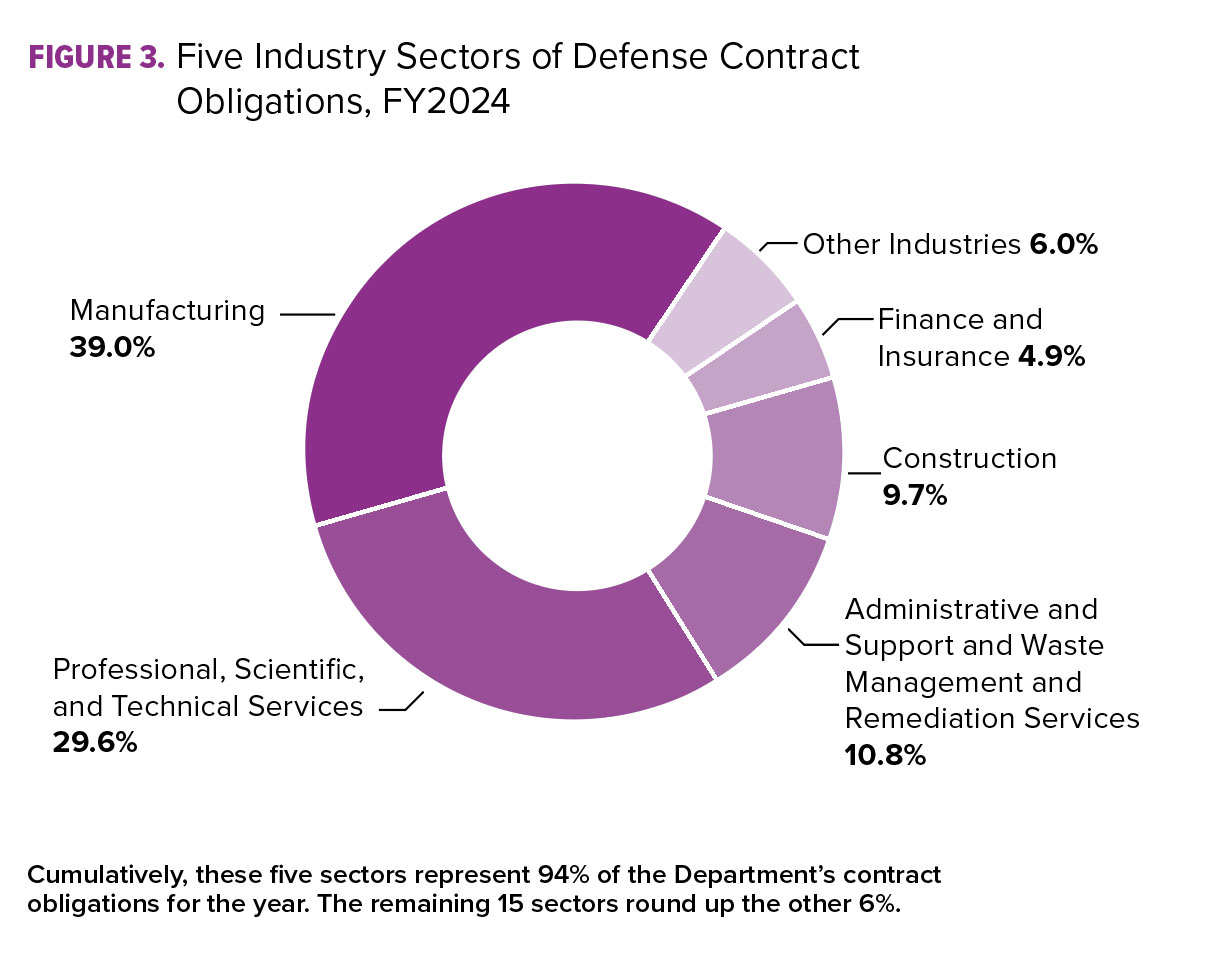
The incentive program’s genesis was to support the war effort. I posit that the federal government’s powers and responsibilities have grown substantially in the 83 years since the law’s passage. Further, the definition of “war” has changed significantly; while heavily leveraging manufacturing requirements, the Department of Defense obligations also include significant expenditures in professional and technical services, administrative support, construction, and financial services. (25)
Thus, to support the modern-day defense capabilities, industry – including small businesses – must evolve beyond the WWII manufacturing plants to continue aligning with evolving needs and warfighting capabilities.
Congress’s realization of the vital importance of small businesses and the government’s role in ensuring their success led to more comprehensive small business legislation. This was established in the Small Business Act of 1953, (26) which created the SBA. The very first section of the Act proclaimed Congress’s intention:
“… to insure that a fair proportion of the total purchases and contracts or subcontracts for property and services for the Government (including but not limited to contracts or subcontracts for maintenance, repair, and construction) be placed with small-business enterprises, to insure that a fair proportion of the total sales of Government property be made to such enterprises, and to maintain and strengthen the overall economy of the Nation.” (27)
Updated several times through the years, some of the significant changes to the act include:
- In 1958, the Act was renamed the “Small Business Investment Act of 1958” (28) and authorized the creation of Small Business Investment Companies (SBICs) to facilitate small businesses’ access to capital and SBA’s oversight of SBICs.
- In 2017, the Act required reporting the number of awards and dollar amounts of awards to small and socioeconomic category businesses, including the awards to businesses whose small business status has changed. (29)
- In 2020, the Paycheck Protection Program Flexibility Act facilitated loan forgiveness to businesses affected by COVID-19. (30)
Small Business Market Presence
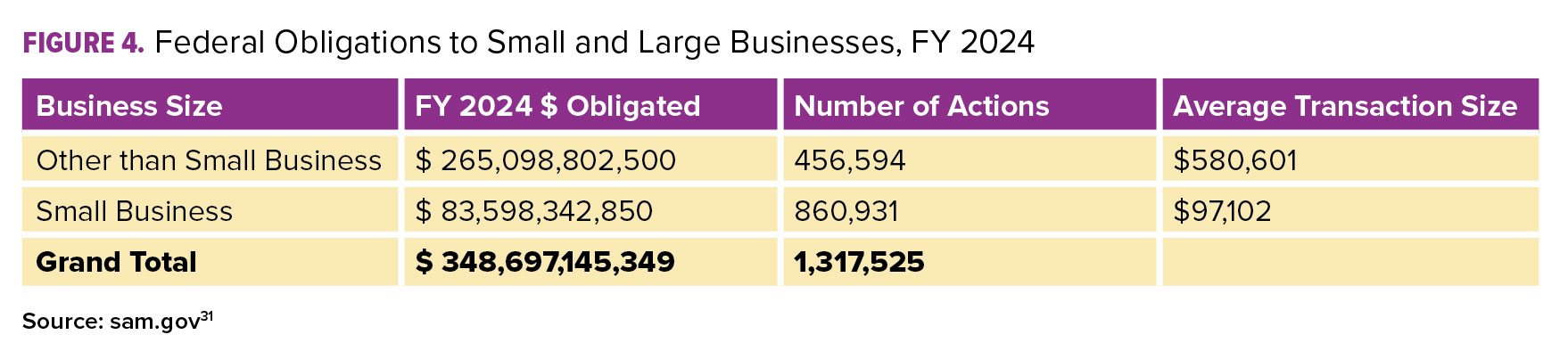
 Awards to small businesses accounted for approximately 24% of total federal contract dollars in FY 2024.
However, when we consider the total number of transactions – those individual obligations, tasks, purchase card swipes, etc. – 65% of individual actions were with small businesses.
The real disparity of outcomes is evident in looking at the size of individual transactions: an average small business transaction is just 17% of the size of a transaction with an other-than-small business. Each transaction represents a purchase request, an obligation, and several signatures. So, it takes a lot more effort for both the agency and the business for the same amount of money to change hands when the small business is the recipient.
Small businesses capture a significant portion of the simplified acquisitions spend; the requirement is that requirements under the simplified acquisitions threshold (currently at $250,000) shall be set aside for small businesses. (32)
Simplified acquisitions are seen as a gateway to federal procurement. The low-risk, less administratively intensive requirements enable companies that do not have experience to compete in massive, complex, and often expensive proposal efforts to enter the market, gain past performance and an understanding of customer agencies, and, in turn, position themselves for greater opportunities and enhanced competitiveness in the market.
Who Benefits From Small Business Programs?

The federal government realizes a double benefit from purposefully engaging with small businesses. It is a buyer of innovative, competitively priced, quality services and products to meet agency missions. It is also a public sector actor that aids those vendors in fulfilling their roles in the economy. Each federal dollar contributes to innovation, job creation, and community development.
Small Businesses
Small business preferences lower the barrier to entry into a complex, highly regulated market. The barriers are high: the government decides what it needs, writes the procedures, conducts competition, decides winners and losers, and has the discretion to change rules at any time. An opportunity to compete for federal contracts at smaller dollar amounts incentivizes businesses to pursue the market without investing significant resources into full-scale capture and proposal efforts.
Limiting the field to a smaller number of competitors that are “similarly situated” – that is, owned and controlled by individuals with similar backgrounds and relatively equivalent resources – levels the playing field and removes any inherent disadvantages of economies of scale and economic resources.
Winning a federal contract is good for business in ways beyond the benefits of economic transactions themselves. A successful bidder builds “past performance” – experience in performing work that can be leveraged on future government bids as a prime vendor and makes one more attractive as a partner in teaming and subcontracting opportunities.
Customer knowledge and experience area golden tickets themselves: knowing a federal agency, learning to speak its unique language of acronyms and terms of art creates insiders whose proposals are better, whose solutions are more insightful, and whose experience is more valuable on the next bid and the one after that.
Federal contractors can also use their federal contracts as financial instruments: lenders use contracts as collateral, facilitating access to capital without risking personal assets.
Taxpayers
As job creators and local economy drivers, thriving small businesses lift their communities. They invest locally and pay taxes that contribute to improved citizen services in their cities and states. Government contracting often provides reliable, long-term revenue streams that support job stability and economic growth.
The services small businesses provide in performing government contracts benefit taxpayers; small businesses are agile, cost effective, responsive, and innovative. They drive results, are accountable to their customers, and generate better program outcomes for the benefit of federal agencies and ultimately the American public.
Large Prime Contractors
Small businesses make solid business partners. Often, subcontracting is the means of entry into the federal market, and small businesses actively seek opportunities to partner with experienced companies large and small that already have a market presence.
There are many incentives for large businesses to partake in subcontracting, including access to small business set-aside opportunities through joint ventures under the Mentor-Protégé program, agility and innovation, cost savings due to lower overhead of smaller enterprises; and long-term strategic relationships with niche subject matter expert firms. (34)
State and Local Governments
Across the state and local public procurement landscape, the need to recognize small, minority, women-owned, and veteran-owned businesses in public procurement opportunities varies widely. Some states, such as Alaska (35) and Hawai’i, (36) express a preference for local producers and manufacturing, but do not have policies regarding business size.
Twenty states (just over half of those with a small business certification program) have a mechanism to effectively include small businesses in a meaningful way in public procurement. On the state level, small business preferences take shape in one of three common methods:
- Procurement evaluation preferences, such as price or bid points
- Thresholds at which procurements include or are competed among small businesses
- Agency-level or statewide goals for small business awards
Tips for Small Business Success
As a business counselor, I’ve witnessed quixotic endeavors (37) of small business owners who try very hard to do the impossible.
I urge you to consider a deeper-dive approach that combines business intelligence with advocacy:

First, do your homework, thoroughly.
Research the agency: do they buy what you sell, through ways you can sell to them? Do they use small business set-asides for your type of products/services? Do they use contracting vehicles (38) that you can sell through as a prime contractor or subcontractor?
Research the opportunity, including incumbent/past/current awards. That includes spending history. (39)
Read strategic plans, directives, and agency priorities the opportunity is tied to.
Identify other programs and contracts at the program office you are selling to. Do you know any of those vendors? Can you form mutually beneficial relationships?
Second, identify strategic approaches to win the work.
Your market research findings will shape your strategy. You will be able to speak to the customer about what they need, how your approach will demonstrate an understanding of that need, and develop a winning solution to address it.
You will get the customer interested enough to want to consider you. You will educate the program office on the best way for them to leverage their customary ways of doing business to reach you – or hold their hand by identifying new approaches.
Third, engage with your champions.
At the same time, you will want to foster other relationships with small business office representatives to make them aware of a savvy, capable, responsive, and responsible company that has the determination, skill, and agency knowledge to not only win the bid, but successfully perform the work. (and who can help the department contribute to its small business goals).
You should also build a relationship with any current prime contractors that could be teaming partners, prime contractors, or subcontractors. They can introduce you, may be able to include your work on their existing requirements, or they may be your subcontractors.
Fourth, fight for your right.
By now you’ve invested a lot of resources in “capturing” and pursuing an opportunity. It would be a waste to let it slip through your fingers. While the government is in the driver’s seat and has ultimate decision-making authority (which includes the right not to decide), (40) there are a few steps you can take to ensure that the government considers you:
- Before the bid: Participate in all industry outreach and market research efforts. That includes responding to requests for information (RFIs) and “sources sought” notices (41) and follow up regarding the status or the ensuing procurement.
- At the time of the solicitation: If you believe that the requirement should be a set-aside (and it wasn’t), or it was a set-aside for small business (and it should have been a set-aside for a socioeconomic category), or if the requirement was unduly restrictive (42) – the agency’s Competition Advocate will help review the requirement to ensure that the contracting officer made the right determination. Note that under the Kingdomware (43) and Tolliver (44) case law, the decisions to create a set-aside must be made at the requirement level, notwithstanding the presence of contracting vehicles. That means that an agency cannot decide to solicit a requirement for a service or a product through an existing vehicle without first conducting an analysis to determine whether that specific procurement could be set aside for small or socioeconomic businesses. Contracting vehicles must be considered only after a small business set-aside determination is conducted.
- As a subcontractor: One way to make the case for small business inclusion is to recommend that agencies include robust subcontracting or small business participation plans. If the acquisition is too complex for small businesses to perform, laying out a case for specific segments that could be successfully done by small businesses could help the agency in crafting its small business plans, with the added benefit of helping the agency comply with its small business subcontracting goals.
Addressing Fraud and Abuse
I would be remiss in painting a rosy picture without acknowledging a few cautionary tales. Yes, small business set-asides have been subject to fraud and abuse. In a 2021 bipartisan congressional letter to the SBA, legislators voiced “longstanding concerns about fraud in small business set-asides” (45) that allows bad actors to game the system through misrepresentation, “straw-owners,” and shell companies.
Examples include improperly formed joint ventures that allow ineligible large bidders to improperly represent themselves as small businesses; (46) outright lying about eligibility for set-asides, such as through the SDVOSB program, (47) and a villainous hat trick, fraudulently obtaining paycheck protection and economic disaster loans while failing to deliver COVID-19 protective equipment and lying about SDVOSB status. (48)
As the U.S. Department of Justice noted in writing about The False Claims Act, “The Department of Justice obtained more than $2.9 billion in settlements and judgments from civil cases involving fraud and false claims against the government in the fiscal year ending Sept. 30, 2024.” (49)
The government contracting community bears a responsibility to be vigilant about preventing fraud and abuse. After all, such wrong-doers undermine the integrity of small business programs, denying legitimate small businesses a chance at contracts making agencies more wary of small businesses, and raising administrative burdens on those trying to compete in good faith.
What can you do? Keep your own house in order. Avoid potential inadvertent violations by understanding the rules. Don’t sign agreements that don’t pass the sniff test; avoid dealings with companies that cut corners, skirt the truth, or make you feel uneasy about ethics.
If you see something, say something. There are numerous paths to report suspected fraud, including the agencies’ inspectors general, the agencies’ whistleblower protection offices, the Small Business Administration ombudsman, the Department of Justice, or the Defense Contract Audit Agency.
Systemic issues require strength in numbers. If you identify issues that transcend a single vendor, it might literally require an act of Congress to fix the problem. Developing a rapport with your legislators is always a great idea (especially to make them aware how many jobs you create in your district). However, business associations such as chambers of commerce, industry-specific groups, or small business associations can be valuable assets to amplify your advocacy.
What’s Ahead for Small Businesses
Small businesses are ready and more than willing to support federal government requirements. Their earnings fulfill an essential economic role, contributing to innovation and new product development, job creation and retention, and community development.
Small businesses serve key roles as providers of services and supplies directly to agencies and large prime contractors, contributing to complex worldwide missions. Small businesses play critical roles in supporting a range of essential services, including major construction, weapons systems, information and financial technologies, and professional services at the state, local, and federal government levels.
Their success as part of the nation’s supply chain is essential to fulfilling the government’s mission and contributing to the economy. By easing the barriers to access for small businesses, government can facilitate the economic stability and growth of these enterprises, ensuring their long-term contribution to the country’s prosperity, security, and strength. CM
Anna Urman is an accomplished federal procurement policy analyst and small business advocate, recognized for her engagement and collaboration efforts between government and industry. She has held leadership positions in federal agencies and served as Director of the Virginia APEX Accelerator. Urman started her government contracting career at an industry-leading data aggregator and ran her own government contracting consulting firm. In her free time, she is a dog rescue volunteer, and the graphic elements are a nod to that cause.
ENDNOTES
1 Edward Hyatt, The ‘Shrinking’ Defense Industrial Base: An Exaggerated Phenomenon?” NCMA March 2025, p. 22, citing Akcigit and Ates, “Ten Facts on Declining Business Dynamism and Lessons from Endogenous Growth Theory.”
2 U.S. Chamber of Commerce Small Business Data Center, https://www.uschamber.com/small-business/small-business-data-center#:~:text=45.9%25,already%20been%20filed%20this%20year.
3 Bureau of Labor Statistics, The Economics Daily https://www.bls.gov/opub/ted/2024/small-businesses-contributed-55-percent-of-the-total-net-job-creation-from-2013-to-2023.htm May 2024
4 U.S. Chamber of Commerce, supra.
5 Small Business Administration, https://advocacy.sba.gov/2024/07/23/frequently-asked-questions-about-small-business-2024/#:~:text=There%20are%2034%2C752%2C434%20small%20businesses,of%20all%20private%20sector%20payroll.
6 “Startups spark more innovations in emerging industries than established companies do” University of Texas at Austin https://www.eurekalert.org/news-releases/1032838
7 Mercedes Delgado and Karen G. Mills, “The supply chain economy: A new industry categorization for understanding innovation in services” Research Policy Volume 49, Issue 8, October 2020 https://www.sciencedirect.com/science/article/abs/pii/S0048733320301177
8 National Federation of Independent Businesses (NFIB) SMALL BUSINESSES’ CONTRIBUTION TO THE COMMUNITY 2024 https://nfib.com/wp-content/uploads/2024/11/2024-Small-Business-Contribution-to-the-Community-05.pdf
9 Id.
10 Bureau of Labor Statistics, The Economics Daily, supra.
11 https://www.sba.gov/sites/default/files/2024-09/Updated_Size_Standard_Methodology_WhitePaper_2024_Proposed_508_v0.pdf
12 https://www.sba.gov/document/support-table-size-standards
13 Id.
14 https://tile.loc.gov/storage-services/service/ll/uscode/uscode1940-00905/uscode1940-009050a026/uscode1940-009050a026.pdf
15 Small Business Mobilization Law of 1942, 50a U.S.C. §§ 1101-1112
16 Id. § 1102(4)
17 Id. § 1102(3)
18 Id. § 1102(6)
19 Id. § 1102(7)
20 Id. § 1102(8)
21 https://www.defensemedianetwork.com/stories/chips-war-dog-hero-of-the-3rd-infantry-division/
22 https://dair.nps.edu/handle/123456789/3955
23 According to Amortization.org, that amounts to $14,679.30 in 2025, with an average inflation of 3.5% from 1947 to 2025.
24 I would be remiss not to mention a few exceptions in 1947 that did not pass the test of time: professional services; medicines & medical supplies; perishables; and resale goods.
25 SAM.gov Ad-Hoc Data Report of FY2024 obligations, dataset generated on 3/2/2025
26 15 U.S.C.§1631
27 15 U.S.C.§1631(a)
28 Public Law 85–699; 72 Stat. 689
29 Improving Contract Procurement for Small Businesses through More Accurate Reporting Act of 2017, Incorporated within the National Defense Authorization Act for Fiscal Year 2018
30 Pub. L. 116–142
31 SAM.gov Ad-Hoc Data Report of FY2024 obligations, dataset generated on 3/2/2025 www.sam.gov
32 FAR 13.003(b)(1)
33 SAM.gov Ad-Hoc Data Report of FY2024 obligations, dataset generated on 3/2/2025 www.sam.gov. Note, “not competed” is the sum of “Not Competed” and “Not Available for Competition”. “Simplified Acquisition Process” is the sum of “competed under SAP” and “not competed under SAP”
34 See my previous article, “Subcontracting: A Study in Contras(C)ts” article in the May 2024 issue of NCMA Magazine: https://ncmahq.org/Web/Shared_Content/CM-Magazine/CM-Magazine-May-2024/Subcontracting--A-Study-in-Contras-c-ts.aspx
35 https://www.commerce.alaska.gov/web/inv/DEV/SmallBusinessAssistanceCenter.aspx
36 https://spo.hawaii.gov/for-vendors/
37 https://g.co/kgs/vyYynaL The Impossible Dream (The Quest) Song by Richard Kiley
38 What are Government Contracting Vehicles? https://info.winvale.com/blog/what-are-government-contract-vehicles.
39 www.usaspending.gov is a great start. For IT requirements, check out https://itdashboard.gov
40 https://www.rush.com/songs/freewill/
41 https://www.linkedin.com/pulse/please-respond-sources-sought-notices-anna-urman
42 https://www.globalregulatoryenforcementlawblog.com/2022/06/articles/government-contracts/gao-sustains-pre-award-protest-challenging-a-solicitation-as-unduly-restrictive/
43 https://www.va.gov/osdbu/verification/veterans_first_contracting_program_adjustments_to_reflect_the_supreme_court_kingdomware_decision.asp
44 https://ecf.cofc.uscourts.gov/cgi-bin/show_public_doc?2020cv1108-44-0#:~:text=Factual%20and%20Procedural%20Background1&text=United%20States%2C%20Fed.,factual%20background%20and%20procedural%20history.
45 https://oversightdemocrats.house.gov/news/press-releases/oversight-committee-urges-sba-to-take-action-to-combat-fraud-and-protect
46 https://www.pilieromazza.com/watch-your-step-avoiding-false-claims-act-violations-from-limitations-in-subcontracting-and-performance-of-work-requirements/
47 https://bergermontague.com/small-business-contractor-false-claims-part-2/
48 https://www.justice.gov/usao-edva/pr/ceo-pleads-guilty-defrauding-multiple-federal-agencies
49 https://www.justice.gov/civil/false-claims-act